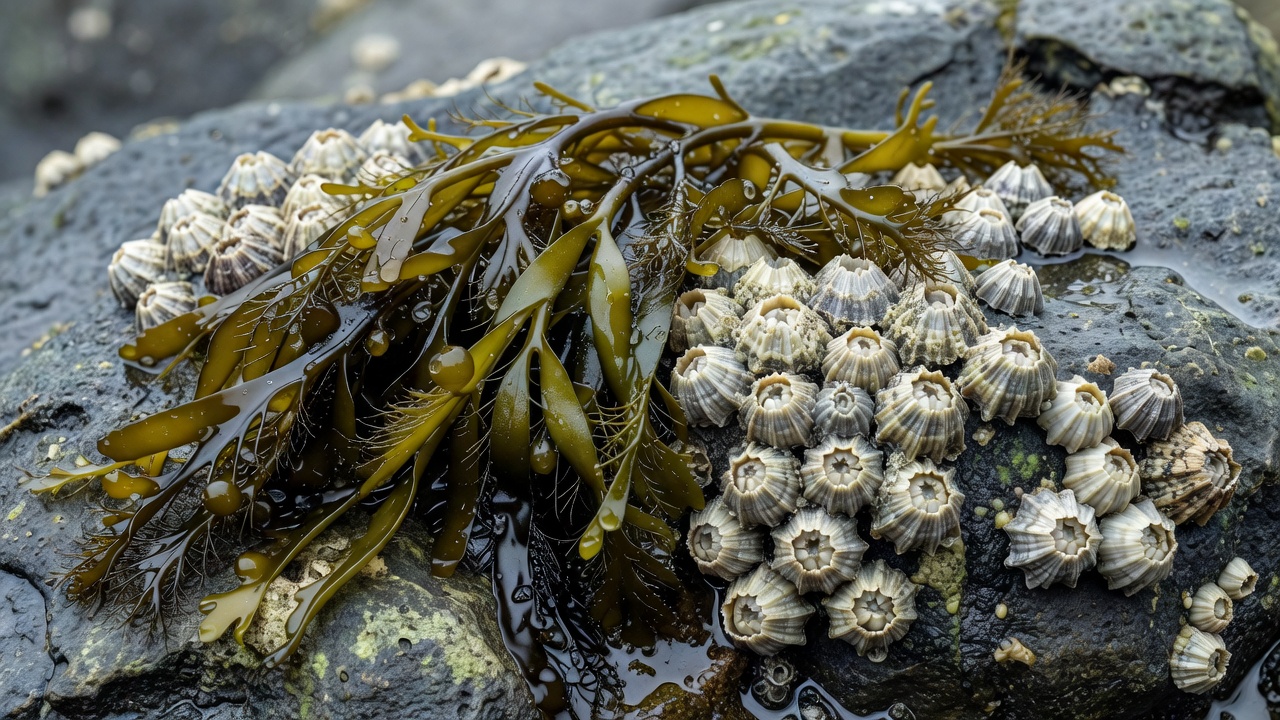
Begin where the water leaves a mark
From a stable path or designated coastal access point, compare the rock above the water with the strip nearest it. You may notice lichens, patches of barnacles, mussels or bands of brown seaweed. These patterns are not arranged simply for visual neatness. Organisms differ in their ability to tolerate drying, wave impact, temperature changes and exposure to less salty water.
The intertidal zone is alternately covered and uncovered by the tide. A photograph records only one stage of that cycle, and weather can raise or lower the water beyond the predicted astronomical tide. Do not use a visible strand line as a guarantee that a rock platform will remain dry. Keep an easy retreat and avoid crossing seaweed-covered rocks for a closer look.
A fjord contains different water environments
Rain, rivers and melting snow deliver freshwater to many fjords. Because freshwater is generally less dense than seawater, it can spread across the surface as a relatively fresh layer. Beneath it may lie saltier water connected to the coastal sea. Mixing, wind, river discharge and the shape of the fjord influence how distinct these layers become. The result changes through time rather than forming one permanent arrangement.
A sill can restrict exchange between a deep basin and offshore water. Deep-water renewal occurs when suitable conditions allow denser water to enter and displace older water. Oxygen is consumed as organisms respire and organic matter decomposes. In some poorly ventilated basins, oxygen can become low. That does not mean all deep fjords lack oxygen, or that still-looking surface water reveals conditions far below.
Rock, sediment and light make different habitats
Rock provides attachment surfaces for seaweeds and many animals. Where enough light reaches suitable subtidal rock, kelp forests can create three-dimensional habitat. Kelp is not guaranteed along every fjord margin: freshwater influence, turbidity, exposure, grazing and available substrate all matter. A dark-looking underwater fringe cannot reliably be identified as kelp from a distant photograph alone.
Sheltered coves may accumulate sand or mud rather than expose bare rock. These sediments support a different community, including organisms that burrow or feed on particles. Eelgrass can occur in suitable shallow, soft-sediment environments. It is a flowering plant, unlike seaweed. Avoid anchoring, trampling or dragging equipment through such habitats, and follow local restrictions rather than assuming every accessible shore permits the same activities.
Follow energy through the system
Phytoplankton use light and nutrients to produce organic material in the water. Seaweeds and other coastal plants also contribute production where conditions allow. Grazers consume living material; filter feeders capture suspended particles; predators connect these smaller organisms to fish and birds. Material that sinks can feed bottom communities, while also contributing to oxygen demand during decomposition.
Freshwater can bring both nutrients and suspended sediment. Fine glacial sediment may make some fjord water appear pale or cloudy, reducing light penetration. Water colour is not a simple measure of ecological health. Algae, dissolved organic matter, bottom visibility, cloud cover and viewing angle can also affect what you see. Laboratory measurements and repeated monitoring are needed to assess water quality responsibly.
Read places without treating them as identical
Sognefjord’s branching system includes varied inner and outer settings, so a description of one sheltered inlet should not be applied to the whole fjord. Hardangerfjord likewise includes differing local habitats and human pressures. At a river mouth, the fresh surface influence may be especially noticeable, while a more exposed outer shore can experience stronger exchange with coastal water.
The Oslofjord is a useful reminder that a celebrated coastal landscape can face substantial environmental pressures. Nutrient inputs, habitat alteration, fishing and climate-related changes can interact, but their importance must be assessed using local evidence. Avoid diagnosing an ecosystem from a single clear-water image or one empty-looking patch of rock.
Observe without collecting
Make a shoreline record with a wide view, a detail photograph and a note of approximate tide state and weather. Describe an unfamiliar organism as a shape or growth form rather than assigning a confident species name. Identification often requires details that a casual image does not capture. Never taste shellfish or assume they are safe to harvest because other animals are feeding nearby.
Leave attached organisms attached, keep hands out of bird nesting areas and do not turn stones for a photograph. Even small disturbances can expose sheltered animals to drying or predation. A careful observer can learn a great deal from the shore’s existing arrangement, while leaving the same evidence available to the next visitor.